
What Happens When AI Enters the Design Process?
On creative control, experimentation, and the experience of designing GLAZ001.
AI is becoming part of the creative process, but I'm less interested in how much it can generate than in how it changes the way we design. As an industrial designer, I've always worked through a familiar sequence: research, sketching, modelling, prototyping, and refinement. Each stage involves a different kind of thinking, and each helps shape the decisions that follow.
With GLAZ001, my first AI-assisted design project, I wanted to experiment with what happens when AI enters that process. Not to replace the steps I already know, but to see what changes when some of the boundaries between them become less defined. What I found interesting wasn't simply the speed of generating possibilities. It was the new relationship between exploration and control.
01 / An experiment, Not a Shortcut
I was researching traditional snow goggles made by Inuit and Yupik peoples. The narrow openings that reduce the amount of reflected light reaching the eyes became the starting point for a contemporary lensless eyewear concept. I began sketching different interpretations of that principle, exploring how the form could wrap around the face while maintaining a strong visual identity.

Early sketches exploring the lensless eyewear concept before introducing AI into the process.
At this stage, the process was familiar. I was making decisions through drawing, studying proportions, and gradually developing a direction. The experiment began when I connected ChatGPT to Rhino to explore how those sketches could translate into three-dimensional geometry.
For the first time in this project, I was able to move from an idea towards an initial 3D form through a different kind of interaction with my modelling software. It didn't remove the design work that followed. But it changed how I entered the next stage.
02 / From Generating to Designing
One of the most interesting aspects of working with AI is how quickly something can begin to look like a finished idea. A form appears. It has volume, surfaces, and proportions. You can rotate it, evaluate it, and begin imagining it as a physical object.
But looking convincing is not the same as being resolved. Once I had the first models, I continued working directly in Rhino, refining the proportions, adjusting how the goggles wrapped around the face, and developing two variations: one with a continuous slit and another with a pattern of perforations. This was where a distinction became clear to me.
Generating a possibility and making a design decision are two different things.
AI helped me reach a starting point. But deciding which proportions worked, which details mattered, and which direction was worth developing still required my own judgement. And perhaps that's one of the more interesting questions AI introduces into creative work: when producing alternatives becomes easier, does the ability to evaluate them become even more important?
03 / Reality Has Different Questions
Digital exploration can take a project surprisingly far. But physical objects eventually introduce questions that cannot be answered by images alone. For GLAZ001, I moved from digital models to paper mock-ups and 3D-printed prototypes.
Trying both versions on a face revealed details that were difficult to evaluate on screen: how the front rested over the nose, how far the sides extended towards the temples, and how the overall form interacted with the face.
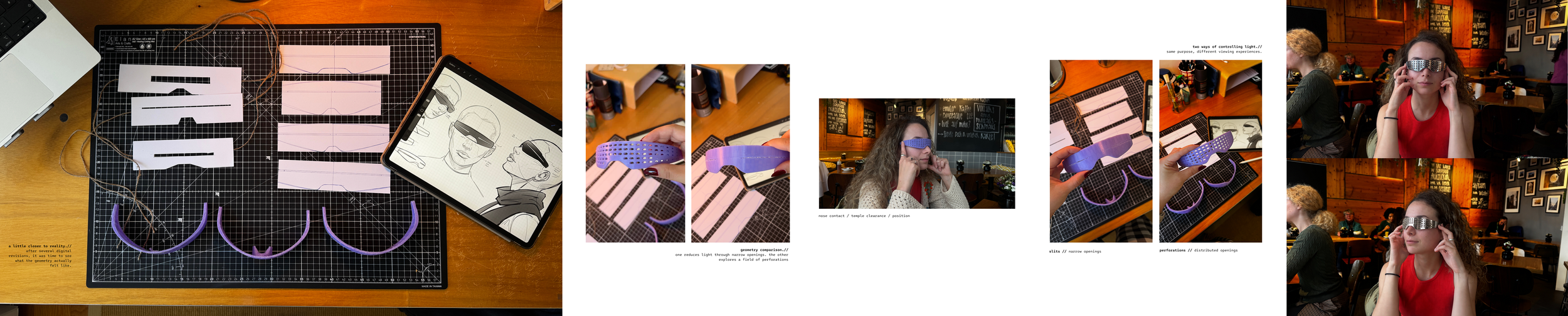
Two physical prototypes exploring different interpretations of the same concept.
I returned to Rhino to make adjustments. Eventually, I chose the continuous slit version because it expressed the original concept more clearly. This part of the process reminded me that a visually compelling idea is only one part of industrial design. Material, scale, ergonomics, and physical interaction introduce their own considerations. AI can contribute to exploring an idea, but a convincing image doesn't resolve these questions. The prototype has its own way of challenging a design.
04 / Directing What Doesn't Exist
The second part of my AI experiment took place after the object had been developed. I wanted to create a visual campaign for GLAZ001, placing the eyewear in environments that would communicate its character beyond conventional studio product photography.
The result was Both Worlds, a campaign exploring the same object across two contrasting settings: an open Arctic landscape and a dark ice cave. AI allowed me to experiment with environments, lighting, styling, and composition without physically producing each scene.
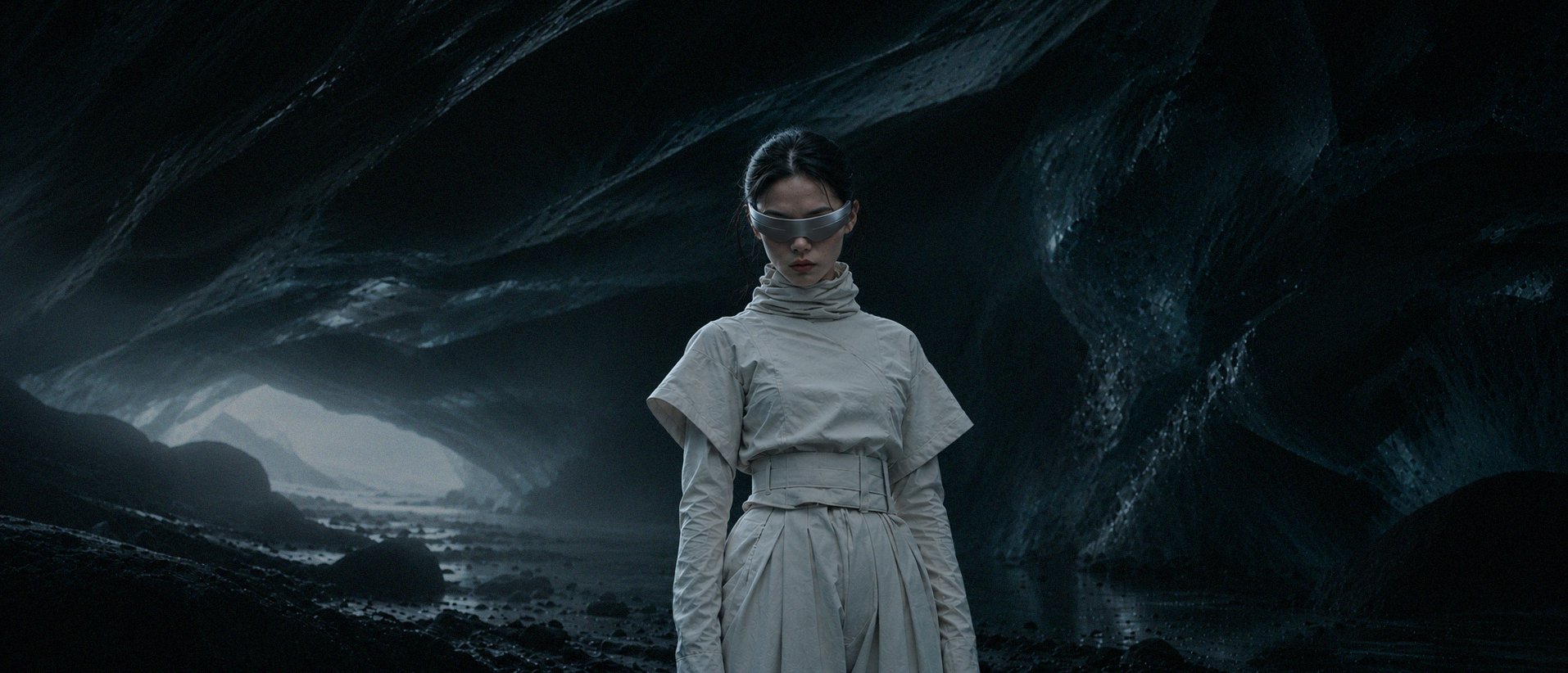
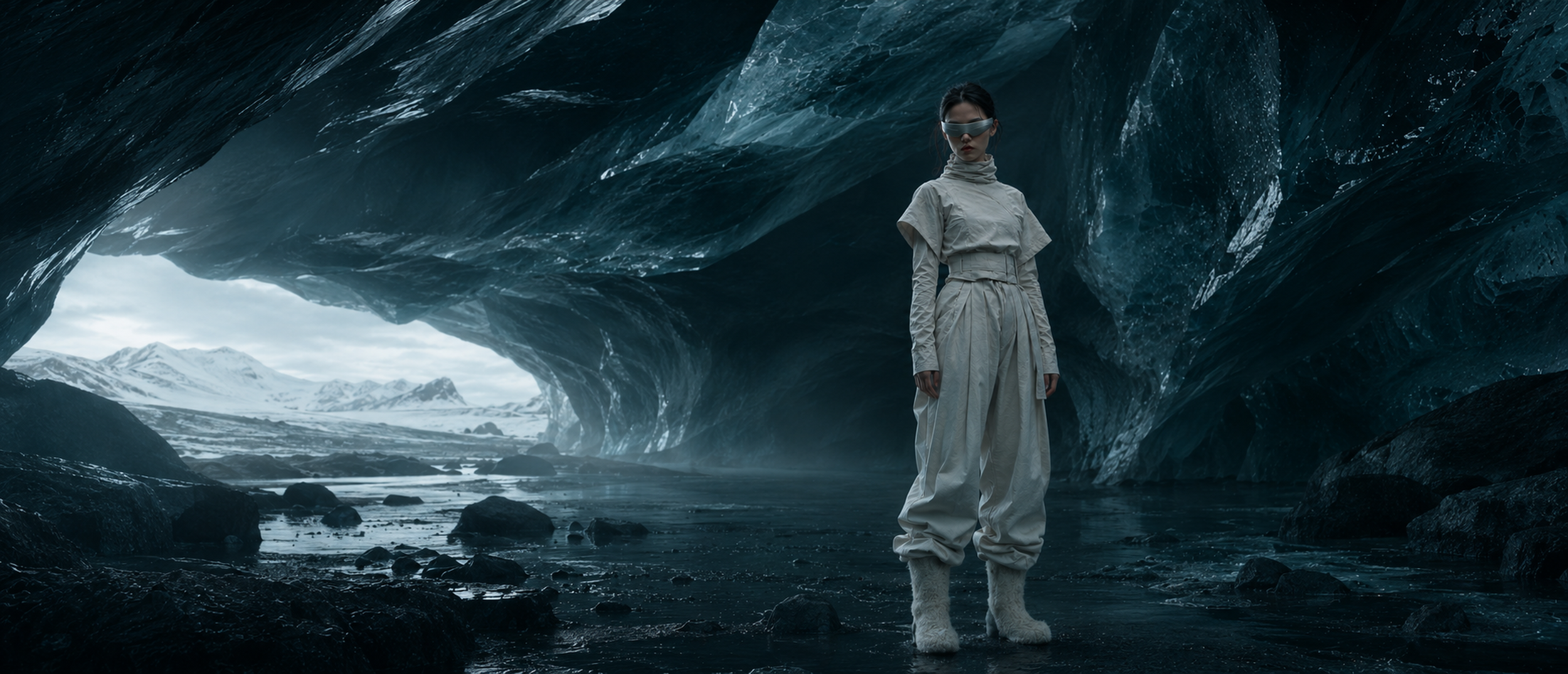
This opened up possibilities that would have been difficult to explore at the same scale within a self-initiated project. But it also introduced a different challenge. Sometimes an image looked visually compelling while the eyewear itself had changed. The proportions were no longer accurate, or the object appeared too large on the face.
I found myself returning to the Rhino model, using it as a reference to bring the imagery back towards the actual design. There was a constant exchange between what the image suggested and what the object really was. And I started thinking about creative direction differently. When images become easier to generate, the work doesn't necessarily disappear. Some of it shifts towards defining intentions, recognising inconsistencies, and deciding what deserves to remain.
05 / What Remains Human?
After GLAZ001, I don't think the most interesting question is whether AI can design. I'm more interested in what designers choose to do with it. Throughout this project, AI played different roles. It helped me move into early three-dimensional exploration, and later allowed me to develop a visual world around the finished object.
But it didn't determine which direction I wanted to pursue, how the goggles should fit, or when an image no longer represented the product accurately. Those decisions remained part of my role. I also realised that faster exploration doesn't automatically mean a better design process. Having more possibilities can be useful, but only when there is a reason to pursue them.
For me, the value of AI was not in removing the designer from the process. It was in giving me another way to experiment within it. And that distinction matters. Perhaps the future of design is not simply about generating more, faster. Perhaps it's also about becoming more conscious of what we choose, what we question, and what we decide to make real.
Notes from the Process
GLAZ001 changed the way I think about integrating AI into my practice. I would use it again, particularly during early exploration and creative direction, where testing different possibilities can open up unexpected directions.
But I would also keep the connection to my sketches, CAD models, and physical prototypes close throughout the process. The most useful moments weren't necessarily when AI produced something unexpected. They were when those results encouraged me to reconsider, adjust, or develop an idea further.
AI expanded the possibilities I could explore. Designing was still about deciding which ones mattered. :)